

Bertolt Brecht’s Collaborators
A review by JJ Amaworo Wilson of Katherine Hollander's new book, Artistic Collaboration, Exile, and Brecht: A New Intellectual History, 1900-1950.
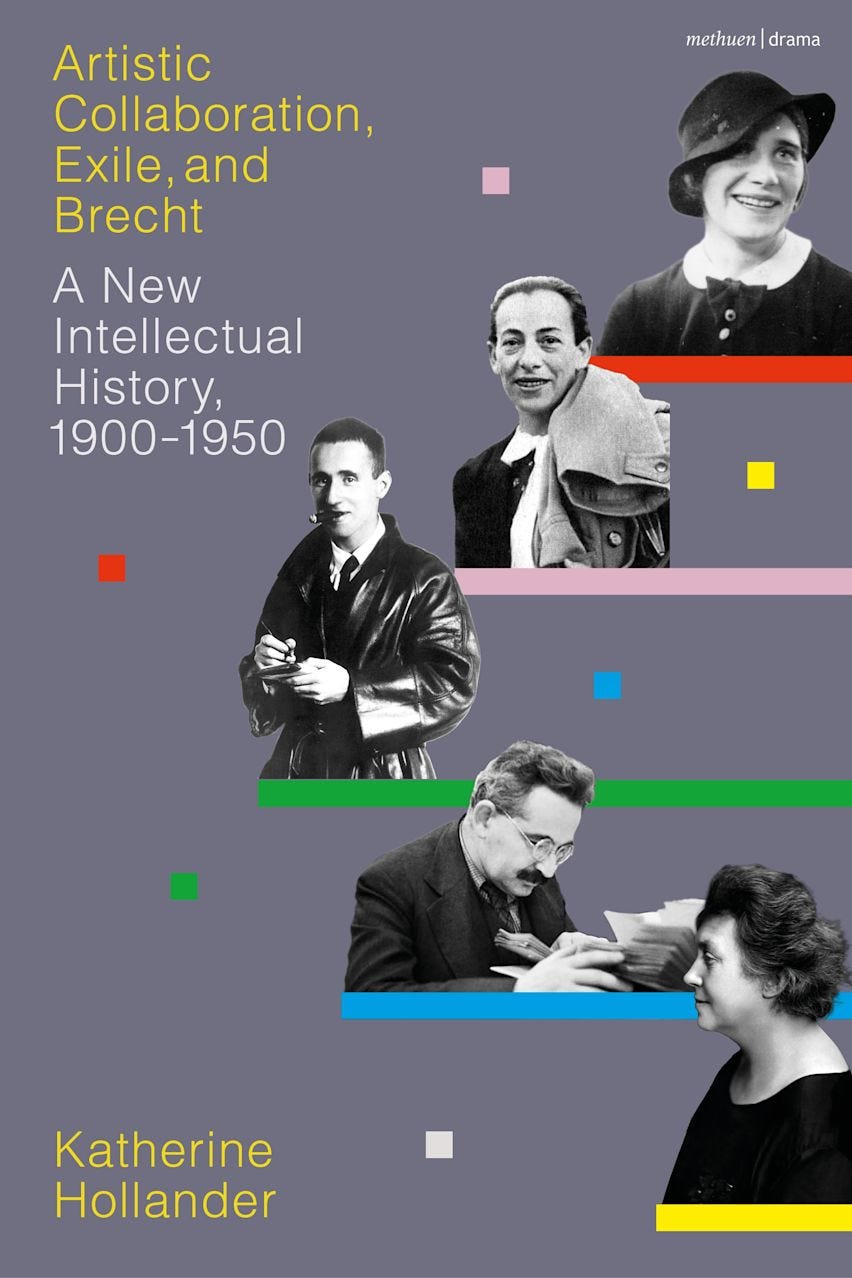
Artistic Collaboration, Exile, and Brecht: A New Intellectual History, 1900-1950
by Katherine Hollander (Bloomsbury Publishing, 2025)
To say Bertolt Brecht had an eventful life would be an understatement. He fathered four children by three women; enjoyed a dazzling career as a playwright and poet; and, in a life punctuated by two world wars, was exiled multiple times as he zigzagged around Europe to escape his Nazi countrymen. Before he died, at the age of fifty-eight, he’d revolutionized European theater.
Brecht was a precocious child. He claimed that public school bored him and that, during his subsequent confinement in high school, he did not succeed in improving his teachers! As a teenager, he began publishing work in the school newspaper and was nearly expelled for writing an essay ridiculing Horace’s line dulce et decorum est pro patria mori. When barely out of school, he earned a reputation for writing scathing newspaper reviews of local theater productions.
Notwithstanding his cockiness, it was clear he was a gifted dramatist. In 1922, he found success with Drums in the Night, which was produced in Munich. Two years later, he moved to Berlin, where he wrote prolifically, became a Marxist, and further developed the theory of epic theater. The theories and techniques he espoused—the alienation effect, breaking the fourth wall for the sake of political commentary—were revolutionary, and several of his plays, such as The Threepenny Opera, Mother Courage and her Children, and The Caucasian Chalk Circle, remain part of the canon and are still produced today.
But did he do it alone? To what extent did various collaborators co-create the dramatic works? And to what extent were their contributions erased because of the collaborators’ gender and in favor of the great man theory of cultural production? These questions animate Katherine Hollander’s fine study, Artistic Collaboration, Exile, and Brecht: A New Intellectual History, 1900-1950.
