

L'Entre-Deux-Morts
Fiction by Marla Braverman. "It was a reasonable mistake. Of the nine victims of the bomb that was planted in a backpack, one woman—at least on paper—was remarkably similar to me."
In the summer of 2002, Marla was killed in the cafeteria of the Hebrew University. At the time, I was halfway across the city, passing the worst of the heat in a late afternoon nap. I learned what happened only that evening, when I turned my phone’s ringer back on. Picture: me with my cell in the crook of my neck, draining spaghetti in the sink. My distracted “Hello?” met with stunned silence, followed by sobs of relief.
It was a reasonable mistake. Of the nine victims of the bomb that was planted in a backpack, one woman—at least on paper—was remarkably similar to me. We both had the same first name, of course, and last names that looked enough alike when you wrote them in Hebrew. Same age, both from Los Angeles, both graduates of UC Berkeley, and both master’s students in Jerusalem, she in Hebrew Bible, me in journalism. One friend was so sure it was me when he first learned of the attack that for years, when we ran into each other, he’d shout, My God, it’s Marla! Man alive!
So when I saw the ad for tonight’s memorial marking ten years since Marla died, I naturally thought I should attend. You know, close the circle. Pay my respects. Which is why Josh and I are now sitting in this Italian restaurant.
“How long since we’ve been here?” Josh asks, sizing up the restaurant’s decor.
“A while,” I say absently, perusing the list of entrees. Apparently, long enough for the prices to rise to a level beyond our reach. The trout is highway robbery. I consider the ravioli.
Dinner out before the memorial had been Josh’s idea. “It’s Marla’s symbolic death,” he’d said. Josh’s doctoral thesis is on Jacques Lacan. “We need to celebrate her life so her soul can rest in peace.”
More likely, he feels guilty about the lack of a Paris trip. Our friends Nate and Yael announced they were going this past Shabbat lunch, a potluck with Nate’s cousin Matt and his new girlfriend, Shari. Yael’s birthday is next month, and Nate surprised her by slipping the tickets in with their stack of mail.
“I almost tossed the whole pile without looking,” Yael said proudly. “It’s only bills they deduct automatically. Mail is so boring in this country.” She linked her arm with Nate’s and rested her head on his shoulder. Across the table, I rolled my eyes at Josh. Stabbed at a green bean.
Yael and I work at a foundation that promotes an inclusive Jerusalem. She writes grants for cultural institutions; I handle gardens and recreation. It was supposed to be a stop-gap job while Josh finished his PhD. Looking back, my mistake is obvious: The job has become too comfortable, the ratty old bathrobe you can’t throw out. Most days Yael and I eat lunch in her office, long gossipy sessions over reheated meals. I complain about our shared boss’s ruinous editing of my work, and she shares tips for crispy baked schnitzel (mix a fourth cup of olive oil into the breadcrumbs). For a while—a long time, even—I thought this was enough. I poured my voice into gorgeous grants for soccer fields in Sheikh Jarrah. I wrote letters to the mayor’s office that read like royal proclamations. But lately, I find myself wondering, Is this all there is? Recently I voiced the question aloud, my plastic fork tracing a vague figure eight in the air above Yael’s desk. She looked up at me blankly. “You’re still hungry?” she asked. I guess you could say that.
Josh and I found the restaurant one night while walking from a bar in the shuk. That was probably eight years ago; at a certain point, you lose count. Tall windows wrapped around three walls, lighting it up from within like the teeth of a jack-o’-lantern. Unlike the places downtown or on trendy Emek Refaim, this one was nestled into an apartment building on a quiet residential street. That meant fewer tourists and fewer crowds. And less chance of an attack. Back in the days when the grim reaper could be every man in a zipped-up coat, walking into your café until—exhale—his wife or girlfriend walked in, too, its remoteness felt like a respite. A small but delicious taste of a normal life.
§
Josh closes his menu and sets it down, having seen the prices for himself. “So this is how the other half lives,” he says, joking. Or not.
I mentally nix my appetizer and smooth the napkin onto my lap. Between my nonprofit salary and Josh’s doctoral stipend, there’s almost nothing left over after we pay our Jerusalem rent. Recently, when I complained we were poor and he said it was a temporary thing, I said, well it’s not like we’re waiting for you to become a real doctor. You know, the kind who earns a decent living. He snapped back that I was welcome to find a more well-paying job myself, and I said, I hate my job, I’m only there for your sake. He yelled that that was bullshit, that there was nothing stopping me. Nothing but inertia, I thought. It had been so long since I’d written something, anything, just for me, I was afraid I no longer could.
A leggy waiter takes our orders, bending ridiculously from the waist to look at our menus as we point. I splurge on a glass of red wine—“For toasting Marla,” I explain. A burst of noise at the door makes us turn in alarm, but it’s only a family pouring in, three generations. A man with a diaper bag on his shoulder thrusts a stroller at the too-narrow frame. Tables are hastily pushed together. From the back, a ponytailed girl appears, shoving chairs like hockey pucks.
“God, I’m starving,” I say. That morning, there’d been a crisis with an elderly British donor: He’d discovered that the Damasks in the peace garden named for his late wife were wilting from the smoke of a nearby shawarma stand. In the flurry of letter writing that followed, I’d forgotten to eat lunch. Too late, I wish I hadn’t mentioned it. Josh is always saying that I’m bad at time management.
“You don’t get points for being a martyr,” he says. “You need to prioritize your lunch breaks.”
Self-prioritization has never been hard for Josh. He once told me that in warm weather he sits in the university’s amphitheater for lunch, so he can look out at the Judean Desert and think without distraction. The image bothered me for a reason I couldn’t quite put my finger on. Maybe it’s that his days were already spent in quiet contemplation. Or maybe it’s that I think I’m the one who needs the quiet breaks more. That’s what he refuses to understand: how draining it is to insist that we’re just one peace garden away from true coexistence.
I’m draining my wine when wooden planks of focaccia are brought out to the large family. Thick pockmarked oblongs of dough. Fat sprigs of rosemary.
“Do you think Nate will propose on their trip to Paris?” I ask, fingering my wine-glass stem. I don’t mean it as a hint; I actually think it’s pretty cliché. But Josh is instantly defensive, leaning away from the table to sit up straight in his chair.
“For God’s sake, Marla, you’re starting this now? We can’t enjoy our night out without you making it some big thing?”
“Jesus, Josh. I was just making conversation.”
“Right,” he says, sarcastic. He picks up his Coke to take a sip, then puts it back when the foam gets stuck halfway down the side of the glass.
“I promise I didn’t mean anything by it. Let’s start over, okay?” We’ve spoken about marriage so many times—after friends’ engagements, after their first kids, when Josh was offered a job at a teaching college but chose to pursue his research instead—that there’s nothing left to say. Even my mother stopped asking about a wedding.
Josh lifts up his hand and shakes it, wriggling his watch back down to his wrist. He’s been shaking that hand for as long as I’ve known him, one of the quirks I’ve always loved most, like how he hums Andrea Bocelli in the shower and folds down the corner of his book page. Josh and I met when my old roommate, Sarah, moved out before her wedding. One evening, her fiancé brought over a friend to help empty the place of her stuff. I’d been offering glasses of water and keeping the hall-light button pressed when her fiancé asked about the armoire in the corner of our living room. Did I want them to carry it down to the street for the garbage men to collect? It was a weathered wood piece with caning in the upper cabinet doors, one of which had a ragged hole near the top, like a pirate with an eyepatch. He listened dubiously as I told him that no, the piece had to stay: It used to belong to our neighbor, a Holocaust survivor who died last year. His nephew was going to ditch it when I offered to take it instead. “He didn’t have any children,” I said, as if that explained everything. “He kept his mugs in there. He always offered us tea.” The next day, the fiancé’s friend called. Did I want to go for coffee at that place on Bethlehem Road?
Making our table wobble on the uneven stones when he shifted his weight, Josh described the subject of his master’s thesis: the application of a Lacanian theory to late nineteenth-century German Jews. They existed between two deaths, he explained, twirling the milk in his latte. Sometimes the first death is biological, but the soul remains in turmoil, haunting the world like a ghost. A second, symbolic death—a burial, for example, or the bringing of a murderer to justice—is essential for ensuring that the soul can at last rest in peace. Or the order could be reversed, and the first death could be symbolic, through a process of othering. That’s what happened with Germany’s Jews: They existed on society’s margins until their biological end. Which occurred, he said, slicing into his cake, with the Nazi extermination.
I told him about my own plans to write human-interest features. Things had been quiet for several years since Operation Defensive Shield; the time was ripe for stories that had nothing to do with terror attacks. Vintners growing grapes in the Negev. Yemenite grandmothers teaching young chefs the secrets of their jachnun. I would be practice to Josh’s theory. Emotion to his intellect.
Walking home that night, Josh offered to sand and repaint my armoire, a way to extend its life. He got as far as the bottom half by the time we were sharing a bed. Then he had finals, and then he forgot. Now it sits on our enclosed balcony, a work forever in progress.
§
I steal a glance at Josh’s watch; it’s later than I thought. Restless, Josh turns over his fork, examining it like a rare artifact.
“Fine, comment forgotten,” he says. “But let’s lay off the digs and hints.” Digs and hints. It sounds like a British pub, a place to nurse my resentments. Across the room, the family erupts in laughter. The grandfather raises his glass in a toast.
“That group came in after us, and they got their food first.” I say it to change the subject, but now I realize I’m pissed off. “I’m going to tell the waiter,” I say, looking around the room.
Josh tells me to calm down. “There’s nothing the waiter can do. He only brings out the food. It’s the chef who determines the order in which everything is made.” He’s cupping the salt grinder as if it’s a prop in an explanation on the mechanics of flight, perhaps, or how bridges hold up their weight. Josh is always explaining things to me, from Camus to cold-brew coffee.
“Excuse me,” I say to the waiter anyway, when I’ve flagged him down. “That family got its appetizer already, but we came in before them.”
“Yes, but they made a reservation,” he says. He’s fiddling with his notebook, eager to get away.
“What does that have to do with anything?” I ask.
“Marla,” Josh says, sharp. The waiter smiles confusedly and takes a few small steps back. When Josh smiles in his direction, he turns and scurries away.
“This is absurd,” I hiss. “Everyone knows it’s first come, first serve.”
“Served,” Josh says.
“What?”
“The saying is ‘first served,’ not ‘serve.’”
There must be something—incredulity?—on my face, because now Josh is backpedaling.
“I’m sure we’re next, either way,” he says, sounding like my letter to the rose-garden donor: Of course you’re incensed your generous donation is dying in cooking-oil fumes. “We have plenty of time before the memorial. Can we both just try to relax?”
I hook my hair behind my ears, nod, and take a breath. Somewhere, Marla’s soul waits in limbo, waiting to be put to rest.
§
“God, that’s awful,” Shari had said at lunch when Josh mentioned tonight’s event. Shari was new to Israel: She’d found religion around the same time she burned out of her finance job in New York. Now she learns Hebrew in the mornings, studies Torah in the afternoons. “Were you good friends?”
When I admitted that I hadn’t known her, she said “Oh!” brightly, as if she was thinking this was all a mistake, this moving-to-Israel thing. So of course I had to explain the connection: how people thought I’d died when she did.
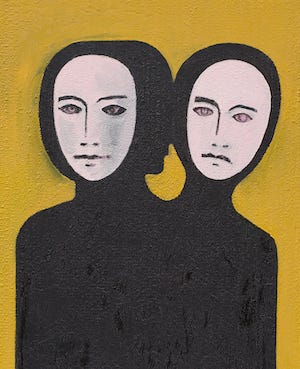
“That’s crazy,” said Shari, wide eyed. “She’s like your—what do you call it? Doppelgänger? Your shadow self.”
Talk of Marla led to the subject of the Second Intifada: the explosions that ripped through the city, Jerusalem one big siren scream. Yael had popped into Café Hillel for a coffee two hours before it blew up. She remembered thinking the cashier was cute; she’d been haunted by his face for months. The bus that Josh rode to his classes was the target of not one, but two terror attacks: once when he’d been home sick, once while he read in the library. And Matt had heard the blast from the Sbarro pizzeria from his parents’ Rehavia living room. We all agreed that one was the worst, as if we were recalling teachers we’d hated back when we were in high school. Seven children, a pregnant woman. Three siblings—boom, all gone. Shari put her fork down on her plate. Tiny clumps of meat floated in red sauce.
In a letter printed after her death, Marla, too, had described the surreal nature of life in Jerusalem then. She knew all the risks, she wrote, how every bus ride and dinner with friends, even a simple walk down the street might end in death or dismemberment. She conceded that it scared her, the implications of every small choice. Still, she insisted, she was staying right here. She didn’t want to be anywhere else. Once I’d shared that same optimism, that unshakeable sense of self. Now that version of me feels like a third cousin: too many degrees of separation.
§
“Listen, I have good news,” Josh says, reaching across the table for my hands. “We’re not only celebrating the other Marla tonight. I didn’t want to say it at lunch, but we’re also going to France. Not Paris, Lyon. But it’s better! Two rivers, a Roman amphitheatre, all those gorgeous traboules. You can eat lunch every day at our neighborhood bouchon.”
“Wait,” I say. Bouchon? “What are you talking about?”
“I’ve been accepted as a post-doctoral fellow at Université Claude Bernard. It’s probably the best university for philosophy in all of France,” he says, raising his eyebrows and tilting his head.
“But, what about a professorship here?” I ask. “Wasn’t that the plan? As soon as you finished your PhD?”
“It was, but this opportunity came up,” Josh says. He sounds wounded, which makes me angry, since I’m the one who’s been blindsided. “It’s a huge honor in my field. And you’re only at your job for my sake, right? I thought that you’d be thrilled.”
Absurdly, I think of my armoire, of its heaviness. Its history. Surely I can’t leave it? Surely he can’t ask me to?
Across the room, the stroller emits a small cry. The dad gives the handle a push, almost bumping our waiter’s hip.
“I hate French,” is all I can manage. And it’s true—all those silent consonants.
“What?” Josh is looking at me like I’m crazy, so I turn my head to avoid his stare. Just then, our waiter reemerges with a tray balanced on each arm. He walks in our direction, stopping short at the table before ours.
“I don’t believe it,” I say, my voice loud enough that the just-served couple turn toward me. “That’s it. I’ve had it.” I crumple my napkin and throw it onto the table, but it’s paper, so it skitters off.
“Marla.” Josh speaks in sotto voice, an attempt to counter mine. “We’ve already waited this long. It’s clearly just a few—”
“I don’t care,” I whisper-shout. “This service is unacceptable. We can’t let them get away with this.” I try to push my chair from the table, but its back legs catch on a groove in the floor. Josh lunges forward as it starts to topple back. My knight in shining armor. Always saving me from myself.
“For God’s sake, M.,” Josh says breathlessly. “Why are you making such a big deal?”
“I never make a big deal. That’s exactly the goddamn point.”
“Miss?” Our waiter is standing next to me, one hand up like the pope.
“Marla,” Josh says again, appealing to logic this time. “You’re not making any sense. If we leave, we’ll have to start over somewhere else. We won’t have time to eat. Let’s just tell the waiter—” Here he looks at him purposefully, earning a dutiful nod—“to ask the chef to speed things up.”
The three of us stand there, a tense little cluster, like those scenes in police shows, the ones where the officer slowly lays down his gun so the hostage won’t get his throat cut. It’s okay, we’re all cool here, right? We’re fine, we can work this out.
The pit in my stomach is an underground chamber where lava rumbles and boils. The moment seems to go on forever, Josh’s expression imploring, the waiter primed to pounce. The middle-aged woman at the nearby table is staring, her mouth a small circle in a nebulous jaw. Barely audible, as if travelling a distance, a voice in my head says, You can leave, you know. You can leave if you want.
It sounds so pitifully hopeful. So pathetically valiant.
As if sensing my indecision, the ponytailed girl arrives with our food. Her steps slow as she approaches, looking between us warily. What feels like now-or-never passes, and I’m dislodged like a leaf from an eddy, borne along by the current again. Plates clatter on the table, a new glass of wine is plucked from the air. Assurances that it’s on the house: All is beseder, yes? I find myself sitting back down, taking tasteless, mechanical bites.
We pass the meal in awkward silence, each of us studying our plates. When our waiter returns to offer dessert, I smile tightly and shake my head. Josh makes a half-hearted effort—They actually have tiramisu!—but clearly, he’s relieved. He practically grabs the waiter to press a credit card into his hand.
§
Our cab to Talpiot winds down trendy Gaza Street. On the corner of Arlozorov, there’s a blur of a yizkor plaque: eleven dead when a bus exploded, its roof and windows blown out. A few blocks later, the old Café Moment, blown up on a busy Saturday night a few months before Marla was killed. Tables crowded with couples spill from the patio up to a fence, enclosing a tiny garden in memory of the victims. A jogger flashes by, a knot of teens lick ice-cream cones. All of them survivors. Everyone in this city.
At eight, when we get to Marla’s memorial, the beit midrash is full. People mill around with hot cups, eating stale rugelach. In front of the ark is an easel on which a picture of Marla rests. Her eyes squint into a smile that reveals both rows of teeth. She has my same dark curly hair, a classic best-friend face. They’ve probably used the same photo at every memorial since she died, a fact that sits like a lump at the base of my throat.
Next to the easel, a childlike woman in glasses is hunched over a laptop. Every few seconds, she looks up at a screen with which hers is meant to communicate. Josh and I sit next to a stylish young woman with a complicated head wrap. We smile briefly at each other, but the closed-lip, serious kind.
“Did you know her?” she asks me.
“Marla? Sort of,” I say. “Our lives kind of overlapped. What about you? Were you two friends?”
She nods. The screen now displays a smiling family mid-hike: the laptop’s wallpaper. An arrow clicks through a series of folders before becoming a loading icon.
“We studied together. In this exact room, actually,” she says. “I still can’t believe she’s gone. She was about to get engaged when she died. She’d probably have four kids by now. She’d have been an amazing teacher, too. She was so full of life.”
I nod at the cliché, arranging my face to convey sympathy.
The slideshow finally ready, Marla’s mother stands up to narrate. We see Marla at four or five in a tutu, a witch costume at Halloween. Marla hugging a grandparent, an older brother, a classmate. Front teeth turned in like a teepee from crowding, later in braces with pink rubber bands. At her bat mitzvah, in a hideous blue bubble dress. In a long black gown at her prom. Smiling in front of the Kotel on a summer trip to Israel. In a cap and gown at graduation. In front of her college dorm. Poring over a book in Hebrew. With her long-time boyfriend, then her fiancé.
Marla ready to take on the world.
Marla full to bursting with life.
“God, Marla, are you alright?” Josh is looking at me in shock. That’s when I notice the wetness, a growing circle between my breasts. There are drops of blood on the lap of my jeans, blood on the hand I’ve brought to my face. My neighbor instantly wrestles with a mini-Kleenex pack, the contents of which I jam underneath my nose as I fumble my way from the room. Bright red drops spring up on the floor behind me like location pins on a map.
In the hallway, as I look for the bathroom, my eyesight begins to spin. Do you lift your head up to let gravity work, or tilt it down to let the flow out? I lean against the wall. The cold of the stone bores into my back, spreads through my shoulder blades.
Josh comes speeding toward me bearing a handful of paper towels. They’re the kind from a bathroom dispenser, stiff and unyielding. He holds the folded wad to my face like the offering of a penitent.
“Is this your version of la petit mort?” he jokes. I give him a smile for trying and taste blood on my upper lip.
“You okay?” He asks.
“I’ll survive,” I say.
He opens his arms and holds me, and I lean into the comfort. I drink it as though I were parched, as if, like the biblical Joseph, I could fill up the granaries for the years of famine ahead.
We stand together, silent, for what seems like endless minutes.
“All done?” Josh asks into my hair.
I nod. Silence gives way to laughter and applause in the beit midrash. Another act of remembrance over, people will head home to bed, dreaming of emails from their bosses, errands they need to run, books they’ve been meaning to write, people they lost and love.
Because that’s what we do, isn’t it?
Marla Braverman is a writer in Jerusalem, Israel. Her fiction has appeared in McSweeney’s, Prime Number Magazine, Jewish Fiction, and Moment Magazine, which awarded her an honorable mention in its 2024 Moment Magazine-Karma Foundation Short Fiction Contest.

Consequence Forum’s Writing Classes
Sharpen your craft, discuss project ideas, and find new writing groups