
The A4 Revolution in China
By C. J. Anderson-Wu. "... many protesters remained silent while holding up blank sheets of paper, the demonstrations represented one of the largest visible expressions of public dissent ..."
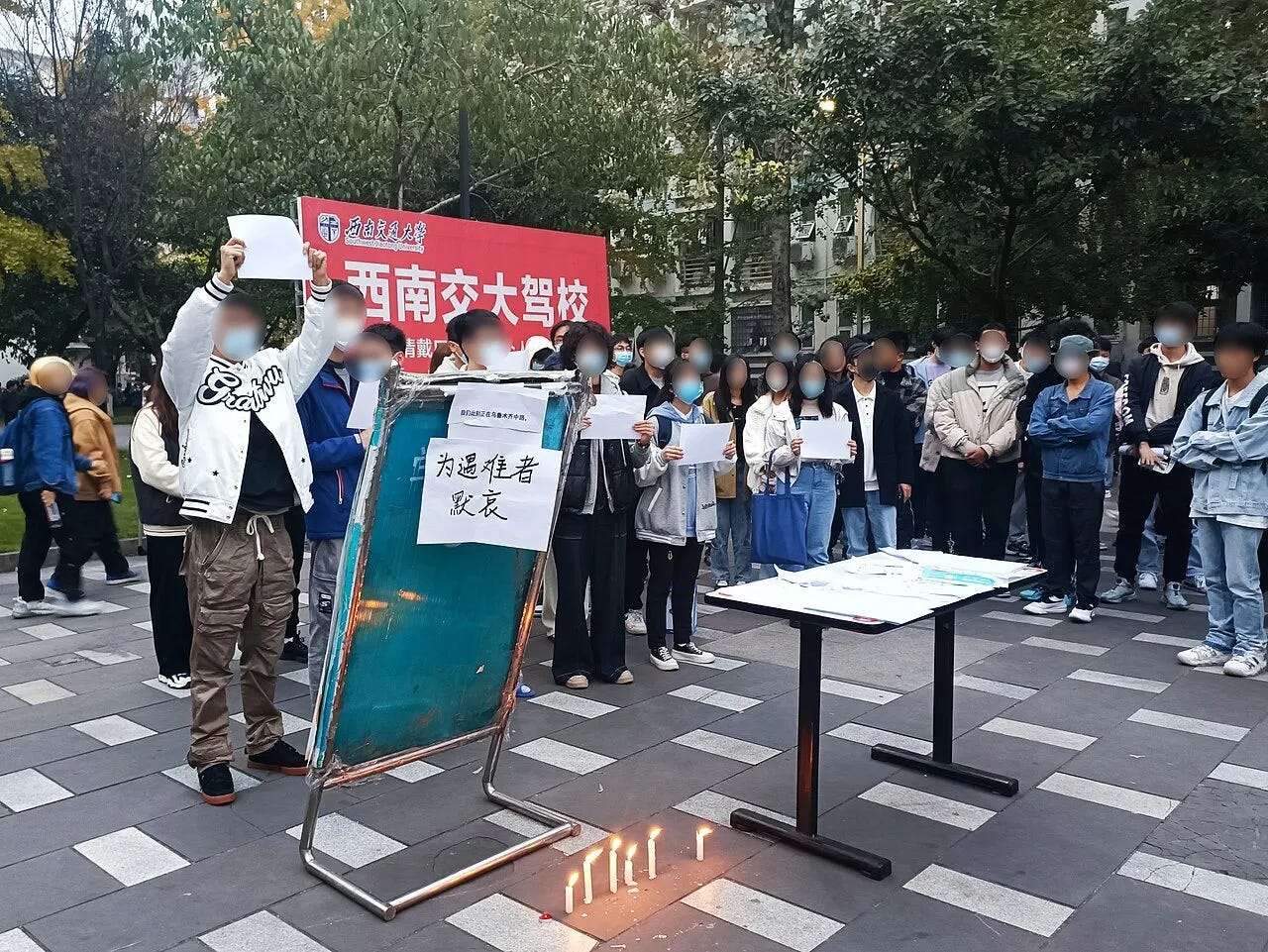
In 2022, during the final phase of China’s zero‑COVID policy, protests originated at the Communication University of China in Nanjing (南京傳媒學院) and quickly spread to multiple cities. Demonstrators from more than two hundred colleges held up blank sheets of A4 paper as a symbol of opposition to censorship and restrictions on free expression. The demonstrations were fueled by widespread frustration with prolonged lockdowns and intensified after a deadly apartment fire in Urumqi. Reports and public concern that residents may have faced obstacles escaping the building due to COVID‑related restrictions further amplified criticism of the government’s pandemic controls.
Although many protesters remained silent while holding up blank sheets of paper, the demonstrations represented one of the largest visible expressions of public dissent in mainland China in decades. While the movement did not develop into a sustained nationwide political organization due to the authorities’ swift repression, it left a lasting impact on Chinese society, state policy, and the country’s activist community.
Policy Changes and Government Response
Shortly after the protests, Chinese authorities dismantled the zero-COVID system that had governed public life for nearly three years. Although the government never publicly linked the policy reversal to the demonstrations, many observers noted the close timing between the protests and the abandonment of strict pandemic controls.
Nevertheless, authorities launched extensive investigations into participants. Human rights organizations, journalists, and researchers have documented detentions, interrogations, surveillance measures, and criminal prosecutions involving individuals connected to the movement. The exact number of affected participants remains unknown, and information regarding some detainees is still incomplete.
Public discussion of the A4 Revolution remains heavily restricted in China. Online references to the protests are routinely censored, and anniversary commemorations have been suppressed. Researchers have described an ongoing effort by authorities to minimize public memory of the demonstrations and prevent their transformation into a broader political narrative.
What Happened to the Protesters
Li Kangmeng (李康夢), a student at the Communication University and believed to be among the first to hold up a blank sheet of paper on campus to protest, is suspected to have been forcibly disappeared. Her whereabouts remain unknown.
In Beijing, Cao Zhixin (曹芷馨) was detained after participating in the Liangma Bridge (亮馬橋) vigil for the victims of the Urumqi fire. Before her arrest, she recorded a video calling for international attention and support, which made her one of the most recognizable figures of the movement. Her friends Li Yuanjing (李元婧), Li Siqi (李思琪), and Zhai Dengrui (翟登蕊) were also taken into custody and formally charged with “picking quarrels and provoking trouble” (尋釁滋事) for their participation in the same protest. Meanwhile, journalist Yang Liu (楊柳) and scholar Qin Ziyi (秦梓奕) were also detained. All of them were held for approximately four months.
Although released, under China’s social credit system—a government‑implemented national rating and blacklist—they are certain to be under close surveillance, with their employment, travel, and social life all subject to disruption.
In an interview three years later, Orange, using a pseudonym for safety, recalled how excited he had been to see so many people gathering and shouting slogans to voice their demands, believing at the time that China truly could change. Unfortunately, after the movement was suppressed, he was interrogated and required to report to law enforcement every two weeks, a routine that lasted for about a year. Orange noted that after this period, the movement was never mentioned again.
But a notable consequence of the government’s post‑protest crackdown has been the emergence of a small but visible community of former participants now living abroad. While many have chosen to remain anonymous for security reasons, several former protesters have spoken publicly about their experiences after leaving China. One prominent example is Rei Xia (夏巢川), who joined the Shanghai protests while returning from the UK and was detained for approximately two months before eventually resuming her studies in Scotland. Xia has since spoken openly about her experiences, advocating for democratic values and human rights, and ultimately relocating overseas permanently.
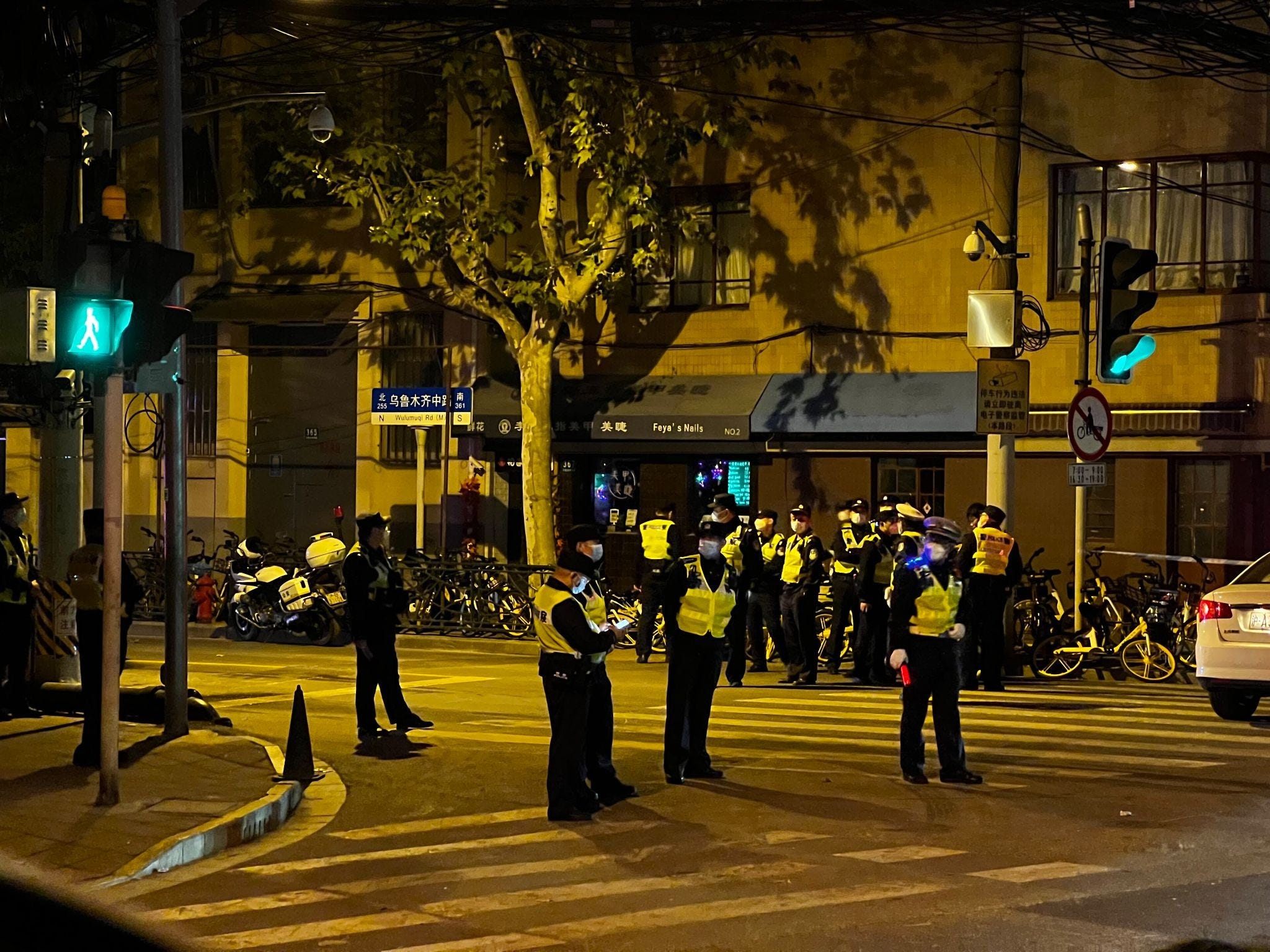
Another participant, Huang Yicheng (黃意誠) was on Urumqi Middle Road (烏魯木齊中路) in Shanghai, mourning with the crowd for the victims of the Urumqi fire in Xinjiang. He did not hold up blank paper or shout slogans, he only called out “Release them” when arrests began. For that, a group of police officers seized him and beat him brutally, dragging his chin along the ground until his face was covered in blood. Fortunately, he managed to escape from the police bus.
In late March of the following year, Huang Yicheng went to Germany to study. He has since been active in speaking out about human rights violations in China.
Other former participants have spoken to journalists under pseudonyms. One such individual, known publicly as Dan Mu (丹木), joined the protests in Beijing and later shared her experiences from outside mainland China while maintaining anonymity for security reasons. She explained that she avoided posting on social media, instead sending information to friends overseas who helped spread the news, which allowed her to escape arrest. Nevertheless, both her own life and that of her family were deeply affected after the movement. Dan Mu emphasized that China’s concealment of the pandemic was absurdly irresponsible and worsened the global situation.
The Movement's Legacy
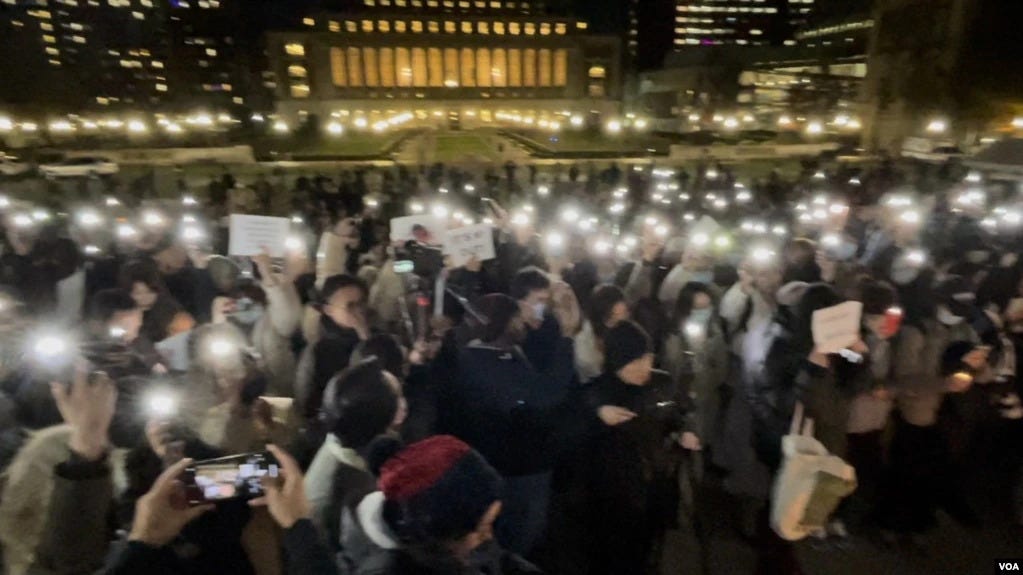
In China, no new nationwide protest wave has emerged since the A4 Revolution. The country’s extensive surveillance and censorship infrastructure continues to make large‑scale coordination difficult. The A4 Revolution itself demonstrated an unusually rare level of cross‑regional public dissent, briefly uniting participants from diverse social backgrounds around demands for greater freedom of expression. Although organized activity inside China remains limited, the movement’s legacy endures through informal networks, overseas advocacy, academic research, media coverage, and annual commemorations organized by members of the Chinese diaspora.
Since the A4 Revolution, many former protesters have deliberately avoided public visibility, fearing retaliation against family members who remain in China or remaining wary of transnational surveillance and pressure. Nonetheless, journalistic and academic reporting shows that a number of participants have relocated to countries such as the United Kingdom, Germany, France, the Netherlands, and the United States. In these places, some have joined broader Chinese diaspora communities engaged in human rights advocacy, political debate, and commemorative events tied to the 2022 protests. These exiled activists have become among the most visible custodians of the movement’s memory, ensuring that the events of late 2022 continue to shape discussions of political expression, state power, and civil society in contemporary China.
Seeta Chiang (蔣不), a young Chinese artist who has settled in Paris since 2019, pointed out, “The A4 Revolution was the first time our generation moved from online to offline action, the first time we openly said ‘no’ to this regime. I believe that remains very important; but even more significant is that the blank sheet of paper may represent a spirit of resistance passed down. No matter where China goes in the future, we hope the A4 Revolution can help form communities overseas, providing nourishment for a civil society. Perhaps we cannot quickly change China’s politics, but at the very least we can make some attempts wherever we are.”
C. J. Anderson-Wu /吳介禎 is a Taiwanese writer and literary activist whose work explores historical trauma, transitional justice, and human rights. Her short story collections Impossible to Swallow and The Surveillance examine Taiwan’s White Terror era, while Endangered Youth—Taiwan, Hong Kong, Ukraine and her poetry collection Clear My Name—Taiwan, Hong Kong, Ukraine expand her focus to global struggles for freedom and sovereignty. Her writing has been recognized by numerous International awards, including Human Rights Art Festival, the Strands Lit International Flash Fiction Competition, the Invisible City Blurred Genre Literature Competition, the Wordweavers Literature Contest, the Premio Letterario Internazionale Città di Arona, and the Miserere Review Writing Competition.

Consequence Forum’s Writing Classes
Sharpen your craft, discuss project ideas, and find new communities