

The Original “Occupy DC” Movement
The 1932 Bonus Army: when war veterans protesting for better benefits faced a military backlash. By J.G.P. MacAdam
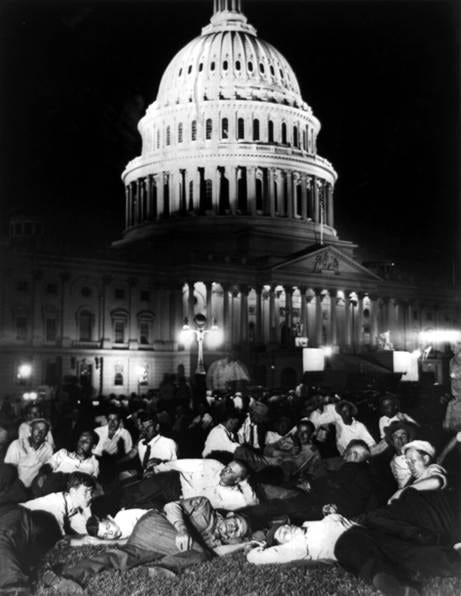
You might say the United States does not always treat its military veterans the way they ought to be treated. That very question, How should a country treat its veterans?, renders a range of responses and circumstances. In Ukraine, those fresh off the battlefield may get treated to a health and mental wellbeing spa, while in India, virtually anyone in uniform is treated to a colloquial salute from children and passersby as they return home from the borderlands.
Today, in the United States, veterans of the armed forces are offered a suite of government benefits. Yours truly achieved a four-year degree from a state school via both federal and state veteran’s education benefits. I treat myself to regular checkups at the local VA clinic, while socking that monthly disability stipend away for a rainy day—tax free.
In addition to the formal benefits, there’s also the seemingly innocuous gestures of gratitude from everyday people and businesses. I recently bought a couple of twelve-foot four-by-fours from the neighborhood hardware store—10 percent off. The clerk responded with a curt, reflexive Thank you for your service while typing in the discount code. I blubbered an awkward thanks, paid, loaded up my four-by-fours, and promptly took them home where I crowed to my wife about how I got ten bucks off.
But times were not always so.
I can’t help but feel that much of the outpouring of support for veterans nowadays is something of a knee-jerk reaction to the yet living memory of how so many veterans were treated all those yesterdays ago—during Vietnam. In those days, as many a wizened, elderly vet have shared with me, you didn’t dare wear your uniform in public for fear someone might throw a slur, or worse, in your direction. Though I have a needling sense that the prior poor treatment of veterans cannot be the sole reason for such recent outpourings.
There remains the specter of September 2001, the institution of an all-volunteer force which cleaves the civilian population from the military one, as well as the rise of, what we might call, Patriot Culture—mostly in the form of Stars & Stripes-themed t-shirts and memes and social media retorts followed by lots of flag-emojis, but which also attempts to meld “patriot identity” with “veteran identity” as though one somehow necessitates the other.
