

The Sheltering Sky
By C. J. Anderson-Wu. "The skies over Taiwan embody this tension. They are at once a symbol of resilience and a sign of fragility, besieged by relentless incursions."
Denied Overflight Permission
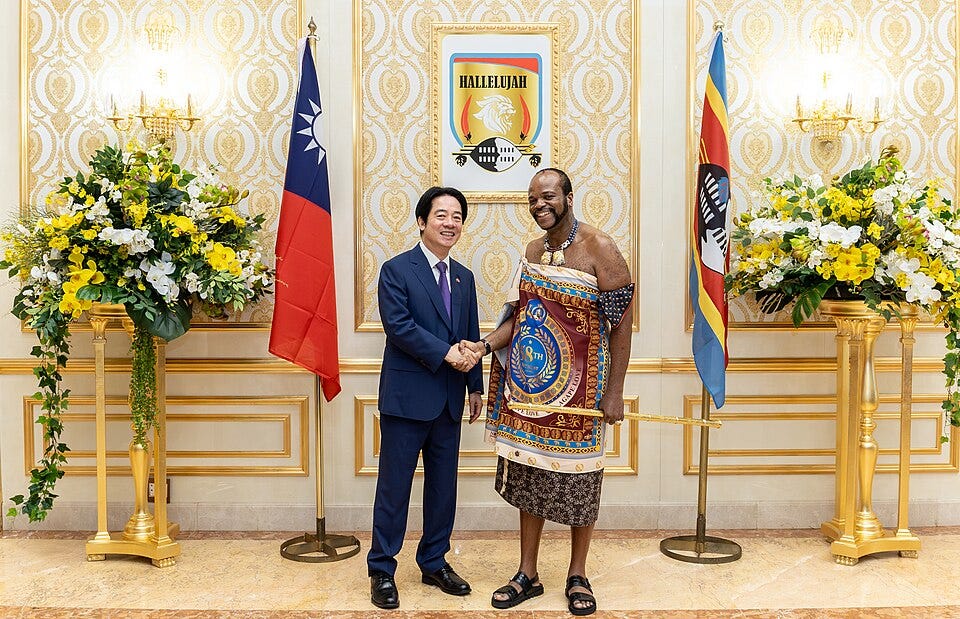
Taiwanese President Lai Ching‑te’s journey to Eswatini in May 2026 became a vivid demonstration of Taiwan’s determination to maintain its global presence despite Beijing’s attempts at disruption.
The trip was not straightforward. Originally scheduled for April 24–26 to coincide with the anniversary of King Mswati III’s coronation, it was disrupted when China pressured several African nations—Seychelles, Mauritius, and Madagascar—to deny overflight permission, forcing Lai to alter his plans. On May 2, to the surprise of many in Taiwan, President Lai successfully arrived in Eswatini. In recognition of his effort to overcome the obstacles and make the visit possible, the coronation ceremony was performed once again in his honor.
On the way to Eswatini, Lai flew aboard King Mswati III’s Airbus A340, taking a route that passed over Madagascar. The return journey on May 4, however, had to be entirely different. To avoid the blocked airspace, Lai’s plane crossed Mozambique and South Africa, then swept southeast across the Indian Ocean before passing over Australia’s Christmas Island, Indonesia, Malaysia, Brunei, and the Philippines, finally reaching Taiwan. This carefully designed flight plan required coordination with multiple countries, underscoring how Taiwan relies on international partners to counter Beijing’s efforts to isolate it.
Eswatini is one of twelve nations that officially recognize the Republic of China (Taiwan), standing firm against Beijing’s threats and misleading incentives.
Daily Harassed Airspace
While the airspace needed for outreach was disrupted, Taiwan’s own airspace remained under constant strain. China’s air force has been harassing Taiwan long before Lai’s presidency. Since 2015, when Tsai Ing-wen was elected as the president, Beijing has intensified its use of “gray zone tactics,” sending military aircrafts into Taiwan’s Air Defense Identification Zone almost daily.
The numbers tell the story: Four incursions in 2015, four in 2016, thirty-four in 2017, thirteen in 2018, twenty in 2019, 380 in 2020, 972 in 2021, and 1,737 in 2022. The pace then accelerated dramatically. Taiwan’s Ministry of National Defense recorded 4,734 incursions in 2023, 5,107 in 2024, and 5,446 in 2025, averaging well over a dozen flights per day, with some days seeing more than twenty sorties crossing the median line of the Taiwan Strait. The incursions serve multiple purposes—military training, political intimidation, and operational probing—but their cumulative effect is to wear down Taiwan’s air force and normalize a state of constant tension.
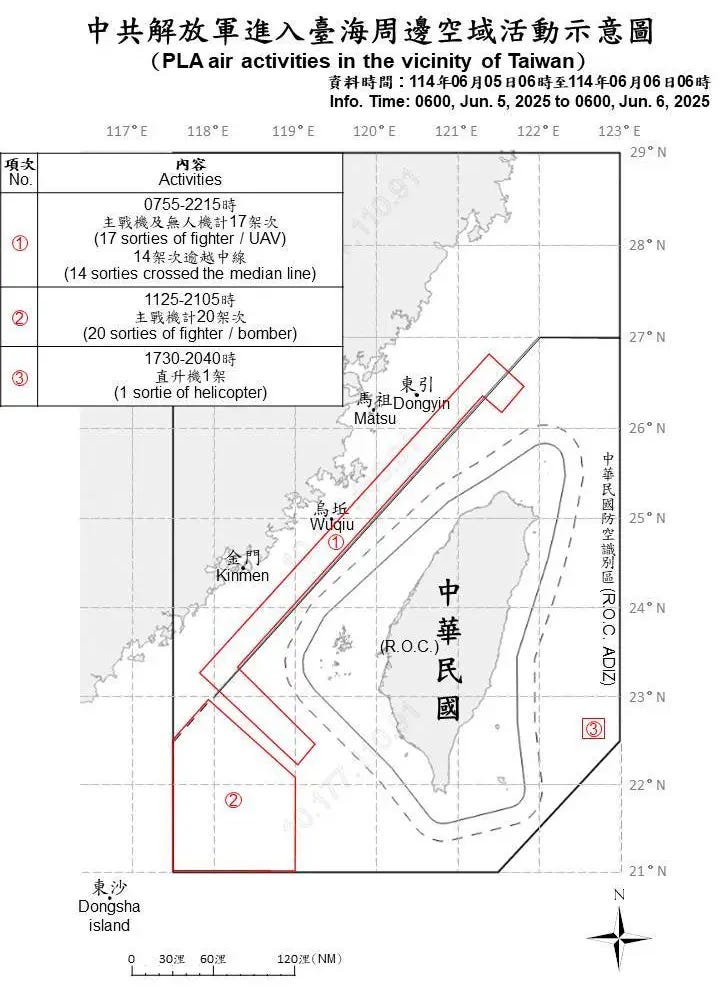
Moreover, China’s large‑scale military drills revealed the extent to which Taiwan’s skies can be weaponized against its daily life. The PLA’s military exercise (absurdly named Justice Mission-2025 in December 2025) designated seven temporary danger zones around the island, effectively sealing off much of Taiwan’s airspace. The impact was immediate and severe: 941 flights were disrupted, including 857 international routes and seventy-nine domestic services to Kinmen and Matsu, stranding more than one hundred thousand passengers. For several days, Taiwan’s skies—normally a conduit of commerce and connection—became a cage of isolation. The episode underscored how military maneuvers can ripple far beyond defense, striking at civil aviation, trade, and the rhythms of ordinary life.
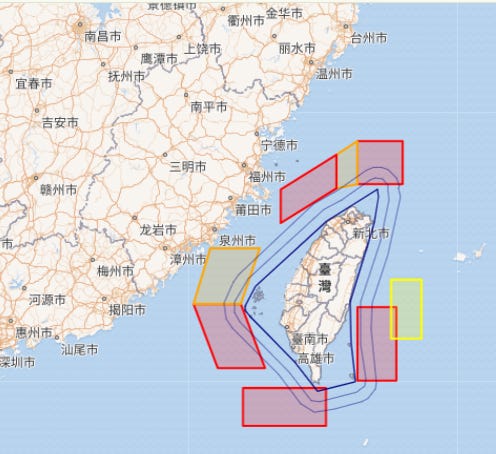
Taiwan’s Ministry of National Defense reported 130 air incursions in one day during the exercise, with ninety aircraft crossing the Taiwan Strait’s median line.
China’s large‑scale and disruptive military exercises began in August 2022, following US House Speaker Nancy Pelosi’s visit to Taiwan. Since then, Beijing has staged seven major drills, each intended to signal its growing pressure on the island.
Against this backdrop, President Lai Ching‑te’s recent trip to Eswatini underscored Taiwan’s paradoxical position on the world stage. His successful arrival, despite Beijing’s efforts to block flight routes, highlighted the island’s determination to reach distant allies and assert its sovereignty. Yet back home, Taiwan faces the daily roar of Chinese military aircraft, a constant reminder of its vulnerability.
The skies over Taiwan embody this tension. They are at once a symbol of resilience and a sign of fragility, besieged by relentless incursions. Lai’s journey to Eswatini was a gesture of defiance, but the ongoing military pressure illustrates the precariousness of Taiwan’s security.
C. J. Anderson-Wu /吳介禎 is a Taiwanese writer and literary activist whose work explores historical trauma, transitional justice, and human rights. Her short story collections Impossible to Swallow and The Surveillance examine Taiwan’s White Terror era, while Endangered Youth—Taiwan, Hong Kong, Ukraine and her poetry collection Clear My Name—Taiwan, Hong Kong, Ukraine expand her focus to global struggles for freedom and sovereignty. Her writing has been recognized by numerous International awards, including Human Rights Art Festival, the Strands Lit International Flash Fiction Competition, the Invisible City Blurred Genre Literature Competition, the Wordweavers Literature Contest, the Premio Letterario Internazionale Città di Arona, and the Miserere Review Writing Competition.

Consequence Forum’s Writing Classes
Sharpen your craft, discuss project ideas, and find new communities
I was just reading how the "new normal" for Taiwan is just constant harassment, even their diplomats being denied entry or held without explanation in other world capitals due to Chinese pressure...
Great piece. Appreciate this perspective. My grandfather retired to Taiwan in the 1980's and eventually died there. I always loved visiting the country, and Taiwan will always have a place in my heart.