
Why Washington Still Misunderstands Iran: Understanding the Internal Struggle Behind the Islamic Republic
By Neamat Nojumi. "... policymakers have ... treated Iran as a foreign-policy challenge rather than as a society ... [struggling] over political legitimacy, governance, and national identity."
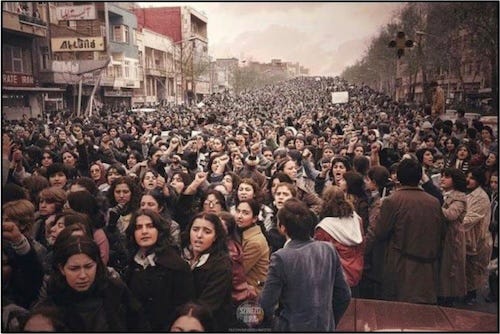
In the spring of 1983, I witnessed an event that shaped my understanding of Iran. In central Mashhad, a young political prisoner stood beneath a crane with a noose around his neck while guards forced onlookers to repeat revolutionary slogans. As he rose into the air, he shouted: Long live freedom. Long live Iran.
Such scenes became commonplace in the early years of the Islamic Republic as thousands of political opponents were imprisoned, tortured, or executed. Yet outside Iran—particularly in Washington—the country came to be understood primarily through the lens of the hostage crisis, terrorism, nuclear disputes, and regional conflict.
That gap in perception lies at the heart of one of the longest-running failures in modern American foreign policy. For decades, US administrations have cycled through sanctions, diplomacy, covert action, and pressure for regime change. The Islamic Republic has outlasted all of it.
The deeper problem is conceptual. American policymakers have consistently treated Iran as a foreign-policy challenge rather than as a society engaged in an ongoing struggle over political legitimacy, governance, and national identity. Understanding why US policy has repeatedly fallen short requires examining the origins of the Islamic Republic, the consolidation of clerical rule, and the generations of Iranians who have challenged it.
A Revolution Misunderstood
The Iranian Revolution is frequently remembered in the West as an Islamic uprising led by Ayatollah Ruhollah Khomeini. That characterization oversimplifies one of the most complex political transformations of the twentieth century.
The revolution did not begin as a unified Islamist movement. It emerged from a broad coalition—liberals, nationalists, constitutionalists, socialists, students, intellectuals, labor activists, religious reformers, and clerics—united by opposition to the authoritarian rule of Mohammad Reza Shah Pahlavi. These groups disagreed sharply about Iran’s future. They shared a common desire for political reform, greater participation, and an end to one-man rule.
Throughout 1977 and 1978, demonstrations spread across the country. As confrontations between security forces and protesters intensified, Khomeini gradually emerged as the most recognizable symbol of resistance. His rise was neither inevitable nor solely the product of events inside Iran.
Following his expulsion from Iraq in October 1978, Khomeini relocated to France. From Neauphle-le-Château outside Paris, he gained unprecedented access to international media. His residence became a political center attracting journalists, intellectuals, and foreign observers. Through interviews, speeches, cassette recordings, and international broadcasts, he reached audiences on a scale unmatched by any other opposition figure.
A critical role was played by a group of highly educated advisers, many of whom had studied or lived in Europe and North America. Acting as translators, intermediaries, and spokesmen, they helped present Khomeini to Western audiences as a moral and spiritual leader seeking justice and democratic reform rather than as the architect of an Islamist clerical state.
That distinction proved enormously consequential. Many Western observers interpreted Khomeini’s calls for an “Islamic Republic” through familiar political frameworks. US Ambassador to the UN Andrew Young and US Ambassador to Iran William Sullivan described him as a “Gandhi-like” figure and “some kind of saint.” They assumed religion would provide moral guidance while democratic institutions governed political life. Few appreciated that Khomeini’s political theory envisioned something fundamentally different: a state in which ultimate authority rested with a religious jurist empowered to supervise all branches of government.
The revolution was misunderstood before it was completed.
*
The Western Gamble
The final months of the Shah’s rule exposed a broader failure among Western governments to read the forces reshaping Iran.
American and European policymakers were primarily concerned with stability. Cold War considerations, regional security concerns, and fear of political chaos shaped their calculations. Khomeini was viewed not as an Islamist ideologue but as a potential stabilizing force capable of unifying a fragmented opposition.
Many policymakers believed a post-Shah order incorporating Khomeini would remain broadly compatible with Western interests. This belief influenced the Carter administration’s decision to dispatch US Air Force General Robert Huyser to Iran. His mission sought to discourage military intervention and prevent a coup by the Iranian armed forces. Critics argue this policy facilitated Khomeini’s return while undermining Prime Minister Shahpur Bakhtiar’s efforts to negotiate a civilian transition. Mounting American pressure for the Shah’s departure, combined with Bakhtiar’s proposal that he temporarily leave the country, convinced Mohammad Reza Shah to go despite strong opposition from senior military figures.
Warnings from secular Iranian politicians received little attention. Bakhtiar and others argued that replacing royal authoritarianism with clerical rule could produce an even more restrictive political order. Their concerns were dismissed amid optimism that the revolution would evolve into a pluralistic system.
History proved otherwise.
*
How the Clerics Captured the Revolution
Political revolutions are often determined less by ideology than by organization. Khomeini arrived in Iran with international recognition that most secular opponents lacked—recognition built through Western media and diplomatic contacts established during his time in France.
Religious institutions provided a further decisive advantage. Mosques and clerical networks constituted a nationwide infrastructure capable of mobilizing supporters, raising resources, disseminating messages, and coordinating political activity. They functioned not merely as places of worship but as communication hubs and organizational centers. Most secular movements had no comparable structure.
As revolutionary institutions took shape, Islamists loyal to Khomeini systematically consolidated power. Rival factions were marginalized, intimidated, or eliminated. Revolutionary committees and militias expanded their authority. New institutions emerged that operated alongside—and often above—traditional state structures.
The most consequential development came during the drafting of the constitution. The doctrine of Velayat-e Faqih—the guardianship of the Islamic jurist—became the foundation of the new political order. Iran retained elections, a parliament, and a presidency. Yet all operated beneath the authority of an unelected Supreme Leader possessing ultimate control over military, judicial, intelligence, and strategic affairs. The result was a hybrid system combining republican institutions with clerical supremacy.
Many participants in the revolution had envisioned a democratic republic. Instead, they confronted a new form of authoritarian rule.
*
Building a Durable Authoritarian State
The longevity of the Islamic Republic cannot be explained by ideology alone. Its survival rests on institutions specifically designed to protect clerical rule.
Revolutionary Courts became central instruments for suppressing political opposition. Thousands accused of opposing the revolution faced proceedings that routinely lacked basic legal protections. The Islamic Revolutionary Guard Corps emerged as the regime’s most important security institution—established to defend the revolution against internal and external threats, and ultimately evolving into a powerful military, intelligence, political, and economic actor. Unlike traditional armed forces, the IRGC’s loyalty is directed not to the Iranian state but to the clerical system itself. The Basij militia further extended the state’s reach through surveillance, ideological enforcement, and protest suppression.
Together, these institutions created a revolutionary state within the state—a network specifically designed to withstand pressure from below.
*
The Hostage Crisis and the Birth of Strategic Misperception
The seizure of the US Embassy in Tehran in November 1979 permanently transformed relations between the two countries.
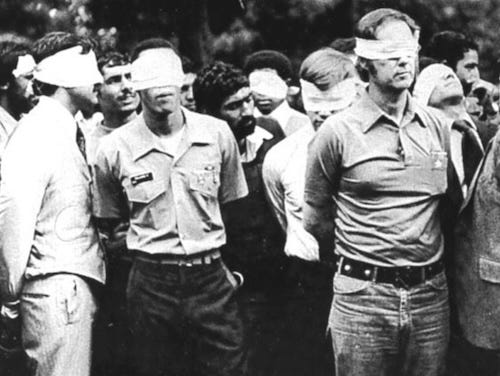
For Americans, the hostage crisis became the defining image of revolutionary Iran. Inside Iran, it served a different function. It strengthened hardline factions, weakened moderates, and provided a powerful instrument for political consolidation. Anti-Americanism became a source of revolutionary legitimacy. Clerical leaders used confrontation with Washington to sideline influential religious figures, eliminate key revolutionary allies, and portray critics as insufficiently committed to the revolution. The direct victim of this anti-American campaign was the collapse of Prime Minister Mehdi Bazargan’s government in protest to the embassy takeover by militants. Bazargan, a revolutionary liberal democrat, was a prominent politician who believed in the separation of religion and state constitutional law and human rights.
From that point forward, Washington viewed Iran primarily through its external behavior. Tehran relied on confrontation with Washington to reinforce internal cohesion. Each side helped validate the worldview of the other.
*
The War That Saved the Regime
When Saddam Hussein invaded Iran in September 1980, Western governments expected the revolutionary government to collapse. Instead, the conflict became one of the principal reasons for its survival.
The war generated national unity, strengthened revolutionary institutions, and enabled the Islamist elements within the regime to present itself as the defender of Iranian sovereignty. This allowed Khomeini to strip Abul Hassan Banisadr, the first elected president of Iran, from the title of the Commander-in-Chief in June 1981. Banisadr, who won 75.6 percent of the vote during the January 1980 presidential elections, was a firm believer of a constitutional democracy and was making serious efforts to reshape the remnant of the country’s armed forces after the Iraqi military invasion. Having the support of senior moderate clerics, Banisadr formed a national coalition with several non-Islamist political parties—parties who won ten million votes during the elections against the four million by the Islamists. He was further deemed a threat when, after a large pro-Banisadr rally that resulted in the IRGC killing fifty protesters, wounding three hundred, and arresting hundred, his supporters went after their attackers and fought them in the streets. Ultimately, and like during the Bazargan’s protest against the US Embassy takeover, Banisadr was viewed as untrusted by Washington. The subsequent IRGC takeover of the presidential buildings forced Banisadr to go into hiding and flee the country to France.
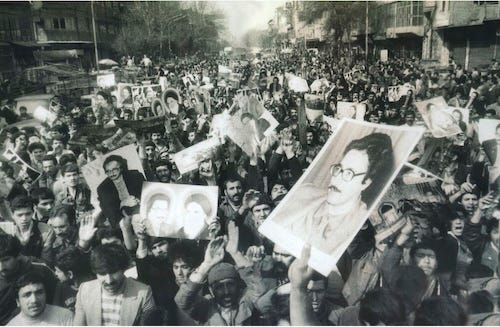
Wartime conditions facilitated mass suppression of dissent while eliminating organized political opposition. The IRGC emerged from the conflict stronger, more experienced, and more influential. Entire generations of political leaders derived legitimacy from their wartime service.
The war also blurred the distinction between opposition to the government and opposition to the nation—a narrative that remains central to regime discourse.
Paradoxically, external pressure strengthened the very system it was expected to weaken.
*
The Persistent American Error
For decades, American policy toward Iran has rested on a recurring assumption: that sufficient external pressure will eventually produce political transformation from within. This assumption misunderstands both the resilience of the Islamic Republic and the complexity of Iranian society. This is why Washington failed to distinguish the wide range of emerging reformist leaders and movements inside Iran from the hardliners.
Iran is not politically static. Since 1979, reformists, students, journalists, labor activists, women’s rights advocates, and civil-society organizations have repeatedly sought greater accountability and political freedom—including many who believed in the revolution but attempted to redefine it for their own generations. These movements have faced severe repression. They also demonstrate that significant segments of Iranian society hold aspirations sharply at odds with those of the ruling establishment.
American policymakers have often acknowledged these aspirations rhetorically while pursuing strategies that strengthen hardline narratives at the expense of reformist movements. Broad sanctions, maximalist pressure campaigns, and calls for regime change enable the state to portray domestic dissent as foreign-directed subversion—what intelligence analysts call blowback.
The pattern is consistent: US support for Iraq’s invasion of Iran, consecutive sanctions regimes, the June 2025 bombing of Iran’s nuclear enrichment facilities, and the February 2026 decapitation strikes by the United States and Israel. In each case, the intended outcome was regime change. In each case, hardliners consolidated power. The killing of the eighty-six-year-old Khamenei produced as his successor a fifty-six-year-old representative of an even harder segment of the ruling elite—a man whose father, mother, sister, wife, and daughter were killed in the bombings of their residence. For this emerging generation of the Islamist leadership, the elder Khamenei has become a martyr whose revolutionary ideals now serve as a source of legitimacy to consolidate the power of those who remain.
The long-term result is a recurring paradox: Policies intended to weaken the regime repeatedly supply it with new sources of legitimacy.
This does not mean the Islamic Republic is invulnerable, nor that external pressure is never warranted. It means that pressure alone cannot transform a political system deliberately designed to survive such challenges— particularly one that has earned an estimated $1.3–1.5 trillion1 in oil export revenues since 1997, funds it has used to build institutions and structures that protect the ruling elite and absorb external shocks.
Meaningful political change must ultimately emerge from within Iranian society itself—a possibility the country’s civilizational history repeatedly affirms, and one now embodied in a sixth generation of reformist and resistance movements.
*
Rethinking Iran
Nearly five decades after the revolution, the central challenge facing American policymakers remains one of understanding.
Iran is simultaneously a state, a civilization, a society, and a political system. Washington frequently reduces it to the behavior of its government—and in doing so, overlooks the internal contest that has defined Iranian politics since 1979.
The most consequential political struggle in modern Iran has never been between Tehran and Washington. It has been between competing visions of Iran itself: one seeking to preserve the clerical order, the other seeking varying degrees of reform, accountability, secularization, and representative governance.
That struggle continues today.
The lesson of the past forty-seven years is not that change in Iran is impossible. It is that change imposed from outside rarely succeeds—and that change emerging from within is repeatedly underestimated.
*
Conclusion
The young prisoner who shouted, “Long live freedom. Long live Iran” from the gallows in Mashhad represented a reality that many outside observers never fully grasped. While countless Iranians experienced the Islamic Republic as a system built on repression and the suppression of competing visions for their country’s future, Washington came to understand Iran through a different lens: hostages, terrorism, nuclear negotiations, regional conflicts, sanctions, and military deterrence.
These concerns were real and important. They also consistently obscured the deeper struggle unfolding inside Iran—and did so in ways that served the regime.
The Islamic Republic emerged from a revolution far more diverse than commonly remembered. It survived because it built institutions capable of protecting clerical rule from both internal and external challenges. It continues to endure not simply because of its coercive capacity, but because foreign observers persistently conflate the regime with the society it governs.
The contrast between the Obama and Trump administrations illustrates how different American strategies can rest on the same flawed premise. The Obama administration sought to reduce tensions through diplomatic engagement on the nuclear issue, hoping stability might create space for gradual internal change. The Trump administration returned to coercive pressure, economic isolation, and ultimately support for measures intended to destabilize the regime. Despite their differences, both approaches treated Iran primarily as a problem of state behavior to be managed from the outside.
For nearly half a century, however, the decisive struggle has taken place within Iran itself. Successive generations of Iranians have challenged, negotiated with, adapted to, and resisted the political order established after 1979. Their struggle—not the latest sanctions campaign, nuclear dispute, or military strike—remains the most important force shaping Iran’s future.
Until American policymakers learn to see Iran through both lenses—the regime and the society, the external challenge and the internal struggle— they will remain trapped in the same cycle of misreading that has defined US-Iran relations since the revolution began.
Neamat Nojumi is the managing editor for The Sentinel Post and is the executive director of the International Cooperation Trust LLC. He is also a Senior Fellow for Transatlantic Relations at the Wisconsin Institute for Public Policy and Services at the Wisconsin University. Dr. Nojumi served as a Senior Advisor for the US government, and worked with international organizations including the United Nations, United States Institute of Peace (USIP), and European Institute of Peace (EIP). He is the author of number of books and articles relevant to the US national security and foreign policy. He is the recipient of personal letters and certificates of achievements from several leaders in the US and UK governments as well as those representing non-governmental agencies.

Consequence Forum’s Writing Classes
Sharpen your craft, discuss project ideas, and find new communities
Great overview. Appreciate this thoughtful analysis